Merry Christmas and a Happy New Year!
Week 4 – Saxons & the Birth of ‘Portesmuða’
Before Portsmouth was a city, it was Portesmuða. Discover how Saxon settlers and a 501 CE battle gave the city its very first name.
HOW PORTSMOUTH WAS SHAPEDHISTORY
Best of Portsmouth
12/22/20256 min read
Early Saxon Portsmouth History (Pre-501 CE)
After the end of Roman rule in Britain around 410 CE, the Portsmouth area entered a period of transition. The Romans had established a stronghold at Portchester (known then as Portus Adurni), one of the Saxon Shore forts guarding the coast. However, there is no evidence of any Roman town on Portsea Island (the island on which Portsmouth would later develop). In the post-Roman decades, the area’s population was sparse and likely consisted of local Britons centred around surviving sites like Portchester. At the same time, large parts of Portsea Island remained marshy and uninhabited.
By the mid-5th century, waves of Saxon and Jute settlers from northern Europe began arriving on Britain’s shores. Southern Hampshire, with its strategic harbours, did not escape this influx. According to historical tradition, Saxon migrants (possibly Jutish clans) settled in the Meon Valley to the east of Portsmouth shortly after 450 CE. These settlers – known as the Meonware – may have been a Jutish group who sailed west from Kent along the Solent and integrated with local communities. Meanwhile, Saxon warriors under various leaders were carving out territories along England’s south coast. By the late 5th century, the Kingdom of the South Saxons (Sussex) had been established to the east, and another Saxon group led by Cerdic had begun the conquest of what would become Wessex (including parts of Hampshire) around 495 CE. In this turbulent context, the stage was set for a Saxon push into the Portsmouth harbour area.
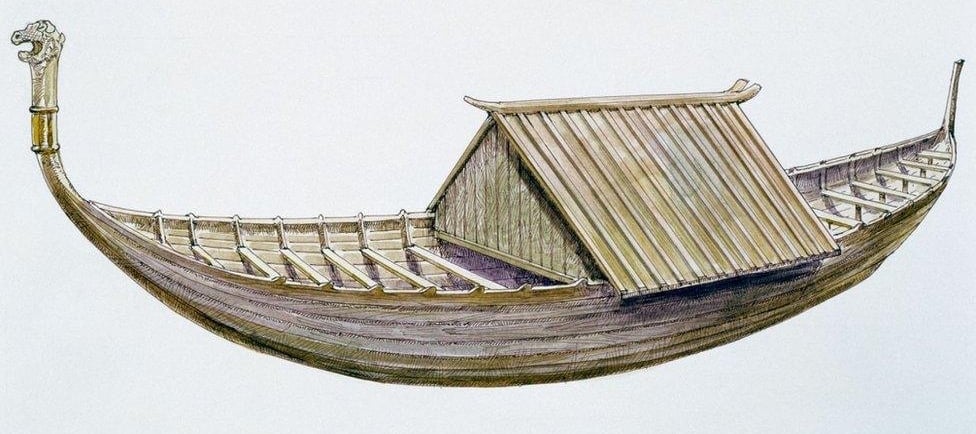
Archaeological evidence supports a growing Saxon presence in the Portsmouth region during the 5th and early 6th centuries. Excavations have uncovered an early Anglo-Saxon cemetery at Southwick Hill (just north of Portchester), suggesting a community of Saxons or Jutes living there in the post-Roman era. Another cemetery was found at Horndean to the north, and various Saxon finds have been recorded around Fareham, at the head of Portsmouth Harbour. One remarkable discovery was a log boat recovered from Langstone Harbour (to the east of Portsea Island), which was radiocarbon dated to about 500 CE. This Saxon logboat indicates seafaring activity in the local waters at precisely the time the newcomers were establishing themselves. In short, both the written record and the soil beneath our feet attest that by 500 CE, the Portsmouth area was witnessing the arrival of new settlers and the dawn of a new era.
Saxon Settlement in Southern Hampshire: Context for Portesmuða
The Saxon expansion into southern Hampshire was part of a broader pattern of settlement and conquest in the south of Britain. While the invaders were pressing inland, coastal strongpoints remained critical. The old Roman fort at Portchester (just north of modern Portsmouth) was one such stronghold – its imposing stone walls would have presented a formidable refuge for the local Britons. By the late 5th century, however, the Saxons had gained footholds all along the southern coast. To the east, King Ælle of the South Saxons had secured Sussex (after landing in 477 CE), and to the west, Cerdic’s Saxons were moving into Hampshire. The Isle of Wight and the mainland around the Solent were also settled by Jutes, who maintained a distinct identity (the Ytene or Jutish people) for some time.
By c. 500 CE, the Portsmouth area formed the western edge of a Saxon-dominated coastline. The stretch from Kent through Sussex to Hampshire was effectively under the control of various Anglo-Saxon groups. This encircled the last pockets of Romano-British resistance in the region. The Britons’ territory of Rhegin (the former Roman Regni kingdom, roughly corresponding to modern West Sussex and southeast Hampshire) was by then squeezed between Saxon domains. It is in this context that the year 501 CE gains special significance: it is the year the Anglo-Saxon Chronicle records a clash at a place called “Portesmuða”, marking the completion of Saxon control over the Portsmouth harbour.
Anglo-Saxon Chronicle (501 CE) and the Name “Portesmuða”
The Anglo-Saxon Chronicle – a collection of annals compiled in Wessex in the 9th century – gives Portsmouth its first mention in recorded history, under the year 501 CE. The Chronicle entry for 501 reads: “This year Port and his two sons, Bieda and Mægla, came into Britain with two ships at a place called Portesmuða, and they soon landed and slew a young Briton of very high rank”. In this stark account, a leader named Port (from whom “Portsmouth” ostensibly takes its name) arrives by sea with his sons and followers, and defeats a British nobleman on the spot. This brief note is the birth of “Portesmuða” in the written record – the moment Portsmouth (or at least its harbour) entered history.
What did this event actually signify? Medieval chroniclers likely viewed it as the founding of Portsmouth in blood and battle – a Saxon victory over the native Britons. The name Portesmuða itself literally means “Port’s mouth” in Old English. To the Chronicle’s authors, “Port” was the personal name of the Saxon leader, and muða meant the mouth of a river or harbour. Modern scholars note that Port is also the Latin word for “harbour” (portus), and Portesmūða probably meant initially “mouth of the harbour (Portus)” – referring to the harbour of Portus Adurni (Portchester). In Anglo-Saxon times, however, a folk etymology took hold: people assumed the place was named after a person called Port, and the Chronicle dutifully recorded a legend of a man by that name ravaging the area. Regardless of its exact origin, the 501 CE entry encapsulates a pivotal moment when Saxon forces seized control of the sheltered harbour on England’s south coast.
The Chronicle’s mention of Port’s two sons, Bieda and Mægla, is also intriguing. These names hint at further echoes in local history. In fact, the name of Bedhampton (a suburb just north of Portsmouth) is thought to derive from Bieda’s ham, meaning “Bieda’s homestead”. Bedhampton appears in later records (the Domesday Book lists it as Betametone), suggesting that the memory of someone named Bieda survived in the area’s place-names. Mægla’s name is more obscure, but some historians have speculated links to broader legends. What is clear is that the Chronicle uses these personal names to give the Saxon conquest a face and lineage, tying the very name of Portsmouth to an origin story.
Portchester Castle – originally the Roman fort Portus Adurni – looms large in this story. In 501 CE, its towering Roman walls would still have been standing firm, likely occupied by local Britons as a last defensive refuge. According to one interpretation, Portesmuða in the Chronicle refers not to Portsmouth city (which did not yet exist) but to the harbour area around Portchester. In other words, Port and his war-band may have landed on Portsea Island (the “island of Port,” as its Saxon name implies ) and then attacked the Britons at Portchester from there. The Chronicle says the invaders “slew a young British nobleman” – perhaps the commander of Portchester’s garrison or a local chieftain of Rhegin. With that victory, the Saxons would have taken control of the entire Portsmouth harbour: the protected anchorage and the fort that guarded it. Contemporary analysis indeed suggests that 501 CE marked the end of organised Britonnic rule in this corner of Hampshire. The fall of Portchester meant the Saxons now commanded Portsmouth Harbour, securing a crucial maritime asset on Wessex’s growing western frontier.
The Legacy of Portesmuða in Saxon Portsmouth History
The skirmish at “Portesmuða” in 501 CE may have been brief, but its legacy was enduring. It was the moment the Saxons planted their flag at the harbour’s mouth, and it established a name – Portsmouth – that would be used for centuries to come. Place-name scholars point out that the term Portesmūða continued to be used in the Saxon era; documents as late as the 9th century still referred to the area by that name, meaning the mouth of the harbour. Over time, as the Saxon language evolved, that name would take the form Portesmuth and eventually Portsmouth.
It’s important to note, however, that early Portsmouth was not yet a town – it was a locale, a harbour, and perhaps a scattering of hamlets on Portsea Island. In fact, Portsmouth is absent from the Domesday Book of 1086, indicating no substantial settlement there at the time. (Nearby villages like Buckland, Fratton, and Cosham are listed, showing that agrarian communities lightly populated the area.) Portsmouth only truly began to develop as a town in the late 12th century, when King Richard I established a borough and port there in 1194. But the Saxon footprint was crucial: those early settlers gave the place its name and laid out villages (Fratton, Milton, Buckland and others trace their names to Saxon origins ). The Saxon settlement of Hampshire had, by the 6th century, firmly integrated the Portsmouth area into the kingdom of the West Saxons – setting the stage for the medieval port to flourish.
In summary, the story of “Portesmuða” in 501 CE – the Anglo-Saxon Chronicle’s dramatic entry of Port and his sons symbolises the moment Portsmouth’s harbour passed into Saxon hands. It highlights the end of Romano-British resistance in this region and the beginning of a new chapter in Portsmouth’s history. From a quiet tidal inlet guarded by an ancient fort, the site would eventually grow (many centuries later) into the bustling naval city we know. The Saxon era in Portsmouth may have been the “Dark Ages” in popular imagination. Still, it was the crucible in which Portsmouth’s identity was first forged – in language, legend, and the shifting control of a valuable harbour on England’s south coast.
Sources:
Anglo-Saxon Chronicle (entry for A.D. 501) – as quoted in saxonhistory.co.uk
Oxford Dictionary of British Place Names – via History of Portsmouth, Wikipedia
Portsmouth Museums – Archaeology (Anglo-Saxon collections)
Local Histories – Anglo-Saxon Portsea Island by Tim Lambert
Heritage Gateway – Historic England record for Portsmouth
History Files – Meonware Jutes (Peter Kessler)
Arthurian Web – on Bieda and Mægla (Bedhampton’s name origin)